
Email at 55

[Photo credit: Khwanchai Phanthong/Pexels]

Ray Tomlinson, the developer of electronic mail (email) who passed away in 2016, didn’t recall the contents of that historic first “network email” message in late 1971. They evidently weren’t meaningful.

“The test messages were entirely forgettable and I have, therefore, forgotten them,” he said.

The notion of sending messages to people through a computer wasn’t new in the early 1970s. The idea had existed for at least the previous decade. Tomlinson was the person who bridged two programs, one that was able to transmit “mail” to other users of the same computer and the other that enabled data transfer from one computer to another through the ARPANET network, a precursor to the internet.

Tomlinson’s first group e-mail explained the new program to users. He reminded them that, to send something successfully, a user must include the “@” symbol between the username and the computer name. He chose it for two reasons: it wasn’t likely to be in a username and it signified “at.”

He initially wanted to keep the innovation private. After his initial demonstration of the new program, one of his colleagues recalled him saying, “Don’t tell anyone! This isn’t what we’re supposed to be working on.”

The initial “spam” message followed in 1978 when marketer Gary Thuerk asked an assistant to enter the addresses of 600 people, inviting them to see a new line of computers during a trip to the West Coast of the US. Theurk was on to something: In 2025, an estimated 45 percent of global e-mail traffic consisted of spam.

According to Feinler and Vittal, the inaugural commercial webmail service was launched in 1995.

Tomlinson’s pursuit of the new means of communications was rather casual. He invented e-mail “mostly because it seemed like a neat idea,” he said. “There was no directive to ‘go forth and invent email.’”

E-mail overtook postal mail in 1996 in usage, and, by 2015, two billion e-mail messages were sent daily. Tomlinson was inducted into the Internet Hall of Fame in 2012 and was honored for “having brought about a complete revolution, fundamentally changing the way people communicate.”

Tomlinson also breathed new life into the “@” symbol. American Underwood typewriters first used it in 1884 to depict an “at the rate of” price designation. After he integrated it into email addresses, the sign took on international significance. It was called a snail in France and Italy, while the symbol became known as “the meow sign” in Finland because its shape resembled a curled-up cat.

The transformational effect of his work wasn’t entirely clear to him years ago. “I’m often asked, did I know what I was doing? And the answer is, yes, I knew exactly what I was doing,” he said. “I just had no notion whatsoever of what the ultimate impact would be,” Tomlinson said.

Never mind the specifics of that first email in 1971.  What will long be remembered is how he changed life. 

References:

Feinler, E., & Vittal, J. (2022, July 1). Email innovation timeline.  Computer History Museum.

Grimes, W. (2016, March 7).  Raymond Tomlinson, who put the @ sign in email, is dead at 74.  The New York Times.  https://www.nytimes.com/2016/03/08/technology/raymond-tomlinson-email-obituary.html

Hutchinson, A. (2009). Big ideas.  Hearst Books.
The “R” in alarm clock sleeping

Photo credit: PIRO/Pixabay

The acronym SCAMPER has been used for decades to generate creative ideas. 

The last letter, “R,” takes reversing the order of something that commonly occurs as a way to develop something new.  Examples include placing the trunk of a car in the front, not the rear, of the vehicle as well as a restaurant that serves dessert at the beginning of the meal.  (Such a place must exist somewhere?) 

I recently read about an “R” example of wellness in a BBC article. 

Eric Verdin, MD, and president and chief executive of the Buck Institute for Research on Aging, is a physician specializing in the aging process and related diseases.  In his work, he knows about the importance of sleep, particularly as people get older. 

Yes, genes can affect sleep patterns, as can factors such as work schedules, lighting, and internet use.  Social jet lag takes place when an individual’s internal clocks become mis-synced with their social clock, which is frequently controlled by external influences of daily life (Straub, 2023).

Many articles about sleep hygiene suggest going to bed at the same time each evening. 

“The reason for this is we’re circadian beings,” Dr. Verdin said in a recent BBC article. “Our whole biology, from gene expression to metabolism is in synchrony with the 24-hour cycle, and so I tell people, going to bed at the same time each day helps your body to stay really well synchronised to all of this.”

However, translating that idea into reality can be difficult.  Too many outside obstacles can interfere.  

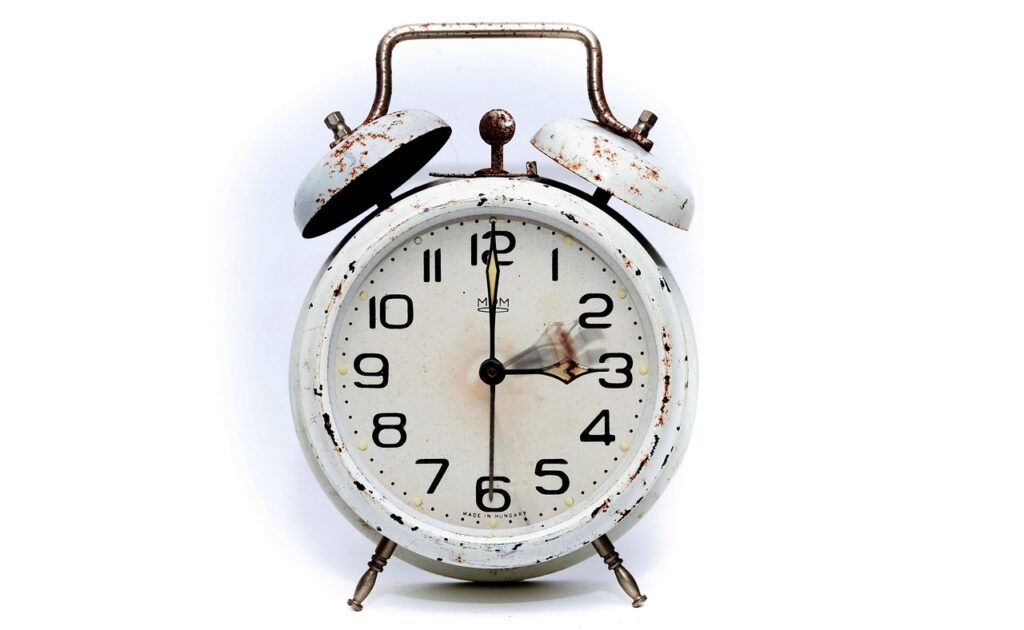
Enter the creative “R” idea from Dr. Verdin.  Instead of considering an alarm clock for waking up, use it for going to bed instead.  That is, set the alarm as an audible mark for preparing to sleep. 

“The idea came front the fact that I wanted to be able to wake up when my body was ready, not when the alarm rang,” Dr. Verdin told me via email.  “I worked on finding out how many hours I needed by setting an alarm in the evening at different times, going to bed, and finding out when I woke up.” 

He eventually decided on a 10pm alarm with a sleeptime around 10:30pm and then waking up spontaneously around 6am.

This alarm clock reminder is an excellent example of reverse ideation…. and probably healthier than eating dessert first.

References:

Cox, D. (2025, November 19). Things you can do in your 30s to improve your health in your 70s.  BBC.comhttps://www.bbc.com/future/article/20251118-things-you-can-do-in-your-30s-to-improve-your-health-in-your-70s

Straub, R.O. (2023). Health psychology: A biopsychosocial approach (seventh ed.). Worth Publishers.

Giving a hand to creativity and innovation

[Photo credit: ajcespedes/Pixabay]

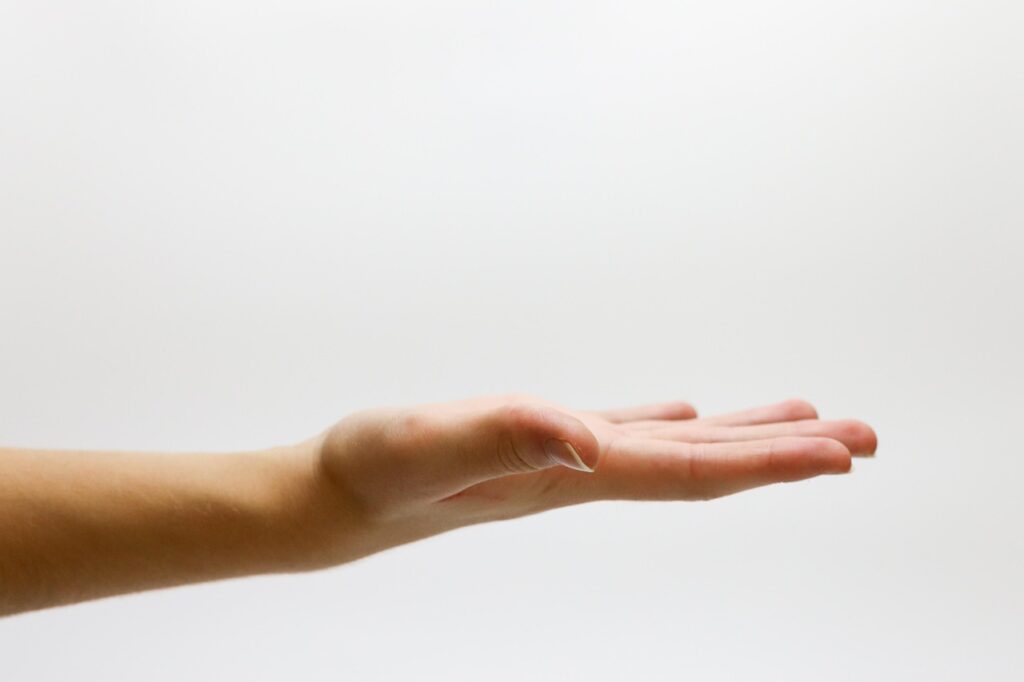
A football quarterback gets paid for “handing off” the ball.  We “give a hand” to show appreciation at an event. “Hands up” is common when seeking volunteers.  Old clothes may become “hand-me-downs.”   Needing help equals “give me a hand.”  Don’t touch means “hands off.”  A bank robber’s go-to lines are “hands up” and “hand it over.”

“Hand-y” references are plentiful in the English language. 

To fully appreciate the beauty of hands, it might be helpful to know some facts.  First, each hand consists of 29 joints, 123 ligaments, and 27 bones (not including the sesamoid bone that can vary in number to each person).  The tips of fingers are vital to the sensations of pressure, pain, and temperature and are critical in transmitting information to the brain to operate in the world.  Fingers don’t even have muscles. In essence, they are “pseudo puppets” that are moved by muscles in bottom of the hand and arm. 

Technically thumbs are not fingers, though the digit is extremely important.  About half of the hand functioning is due to thumbs, which in fact does have nine muscles in all.

I have recently become intrigued with the “hands-on” aspect of creativity.  I remember a visit to a visit to a museum in Santiago, Chile.  Artifacts dating back hundreds of years reflected creative thinking and innovation in clothing, art, and household goods. I marveled at the ideas.  Just how did people living in the 1100s, for instance, devise these items that added innovation to their cultures?

To go back even further, a handprint was recently found in an Egyptian clay dating back about 4000 years.  

This finding along with my museum visit brought a deepened appreciation of the importance of hands in turning creative ideas into tangible products.  Ideas start in our brains, yet it is the hands that frequently implement them. (Note: I do not mean to imply that hands are essential in creativity.  They aren’t.)   As Jacob Bronkowski said, “The hand is the cutting edge of the mind.”

Ever since Greek times, the hand has been seen as having creative powers.  With its agility and tactility, it can move, change, and create things.  In addition, consider the importance of hand gestures in non-verbal communication.  Simply watch a soccer match or basketball game to see how quickly messages can be sent by hand. 

Hands have truly helped humans adapt to the world, having offered people an openness to the world for millenia.  In the words of Gebauer, “…we construct a world starting with our hands, an incorporated and manipulated world.”

I sought the insight of a hand surgeon, who also echoed these points.

“The hand is a unique organ that allows us to intimately interact with our environment to create art, harvest the field, communicate with sign language, hold hands. or to caress a loved one,” said Dr. Robert Goitz, Chief of the Division of Hand, Upper Extremity and Microsurgery in the Department of Orthopaedic Surgery at the University of Pittsburgh School of Medicine. 

“The hand can effectively allow us to interact with our environment with speed, force, and sensitivity that have allowed humans to creatively evolve above all other animals,” he told me.

This body part deserves recognition in the world of innovation.  After all, the future is in our hands.     

References:

BBC. (2025, July 28). Rare 4,000-year-old Egyptian handprint found. https://www.bbc.com/news/articles/cpqvzevep2eo

Gebauer, G. (2019) The creativity of the hand.  Journal of Aesthetics and Phenomenology, 6(2), 185-193, DOI: 10.1080/20539320.2019.1672308

Lloyd, J., & Mitchinson, J. (2008). If ignorance is bliss, why aren’t there more happy people?  Smart quotes for dumb times.  Harmony Books.

University Orthopaedic Associates. (n.d.).  5 incredible things you didn’t know about your hands.  https://uoanj.com/5-incredible-things-you-didnt-know-about-your-hands/