
Photo credit: PIRO/Pixabay
The acronym SCAMPER has been used for decades to generate creative ideas.
The last letter, “R,” takes reversing the order of something that commonly occurs as a way to develop something new. Examples include placing the trunk of a car in the front, not the rear, of the vehicle as well as a restaurant that serves dessert at the beginning of the meal. (Such a place must exist somewhere?)
I recently read about an “R” example of wellness in a BBC article.
Eric Verdin, MD, and president and chief executive of the Buck Institute for Research on Aging, is a physician specializing in the aging process and related diseases. In his work, he knows about the importance of sleep, particularly as people get older.
Yes, genes can affect sleep patterns, as can factors such as work schedules, lighting, and internet use. Social jet lag takes place when an individual’s internal clocks become mis-synced with their social clock, which is frequently controlled by external influences of daily life (Straub, 2023).
Many articles about sleep hygiene suggest going to bed at the same time each evening.
“The reason for this is we’re circadian beings,” Dr. Verdin said in a recent BBC article. “Our whole biology, from gene expression to metabolism is in synchrony with the 24-hour cycle, and so I tell people, going to bed at the same time each day helps your body to stay really well synchronised to all of this.”
However, translating that idea into reality can be difficult. Too many outside obstacles can interfere.
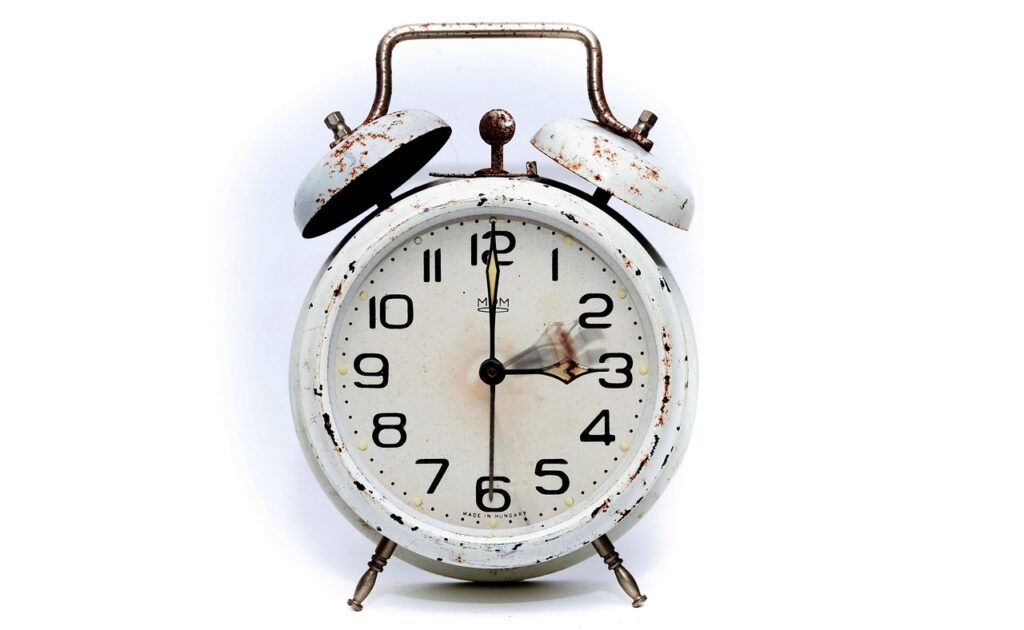
Enter the creative “R” idea from Dr. Verdin. Instead of considering an alarm clock for waking up, use it for going to bed instead. That is, set the alarm as an audible mark for preparing to sleep.
“The idea came front the fact that I wanted to be able to wake up when my body was ready, not when the alarm rang,” Dr. Verdin told me via email. “I worked on finding out how many hours I needed by setting an alarm in the evening at different times, going to bed, and finding out when I woke up.”
He eventually decided on a 10pm alarm with a sleeptime around 10:30pm and then waking up spontaneously around 6am.
This alarm clock reminder is an excellent example of reverse ideation…. and probably healthier than eating dessert first.
References:
Cox, D. (2025, November 19). Things you can do in your 30s to improve your health in your 70s. BBC.com. https://www.bbc.com/future/article/20251118-things-you-can-do-in-your-30s-to-improve-your-health-in-your-70s
Straub, R.O. (2023). Health psychology: A biopsychosocial approach (seventh ed.). Worth Publishers.