
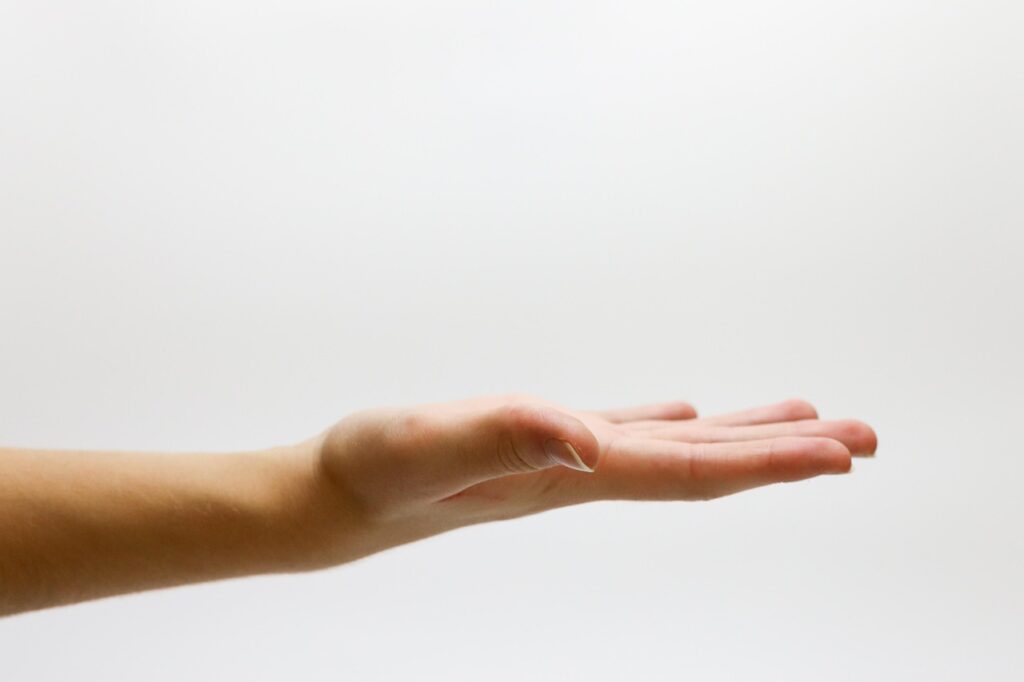
[Photo credit: ajcespedes/Pixabay]
A football quarterback gets paid for “handing off” the ball. We “give a hand” to show appreciation at an event. “Hands up” is common when seeking volunteers. Old clothes may become “hand-me-downs.” Needing help equals “give me a hand.” Don’t touch means “hands off.” A bank robber’s go-to lines are “hands up” and “hand it over.”
“Hand-y” references are plentiful in the English language.
To fully appreciate the beauty of hands, it might be helpful to know some facts. First, each hand consists of 29 joints, 123 ligaments, and 27 bones (not including the sesamoid bone that can vary in number to each person). The tips of fingers are vital to the sensations of pressure, pain, and temperature and are critical in transmitting information to the brain to operate in the world. Fingers don’t even have muscles. In essence, they are “pseudo puppets” that are moved by muscles in bottom of the hand and arm.
Technically thumbs are not fingers, though the digit is extremely important. About half of the hand functioning is due to thumbs, which in fact does have nine muscles in all.
I have recently become intrigued with the “hands-on” aspect of creativity. I remember a visit to a visit to a museum in Santiago, Chile. Artifacts dating back hundreds of years reflected creative thinking and innovation in clothing, art, and household goods. I marveled at the ideas. Just how did people living in the 1100s, for instance, devise these items that added innovation to their cultures?
To go back even further, a handprint was recently found in an Egyptian clay dating back about 4000 years.
This finding along with my museum visit brought a deepened appreciation of the importance of hands in turning creative ideas into tangible products. Ideas start in our brains, yet it is the hands that frequently implement them. (Note: I do not mean to imply that hands are essential in creativity. They aren’t.) As Jacob Bronkowski said, “The hand is the cutting edge of the mind.”
Ever since Greek times, the hand has been seen as having creative powers. With its agility and tactility, it can move, change, and create things. In addition, consider the importance of hand gestures in non-verbal communication. Simply watch a soccer match or basketball game to see how quickly messages can be sent by hand.
Hands have truly helped humans adapt to the world, having offered people an openness to the world for millenia. In the words of Gebauer, “…we construct a world starting with our hands, an incorporated and manipulated world.”
I sought the insight of a hand surgeon, who also echoed these points.
“The hand is a unique organ that allows us to intimately interact with our environment to create art, harvest the field, communicate with sign language, hold hands. or to caress a loved one,” said Dr. Robert Goitz, Chief of the Division of Hand, Upper Extremity and Microsurgery in the Department of Orthopaedic Surgery at the University of Pittsburgh School of Medicine.
“The hand can effectively allow us to interact with our environment with speed, force, and sensitivity that have allowed humans to creatively evolve above all other animals,” he told me.
This body part deserves recognition in the world of innovation. After all, the future is in our hands.
References:
BBC. (2025, July 28). Rare 4,000-year-old Egyptian handprint found. https://www.bbc.com/news/articles/cpqvzevep2eo
Gebauer, G. (2019) The creativity of the hand. Journal of Aesthetics and Phenomenology, 6(2), 185-193, DOI: 10.1080/20539320.2019.1672308
Lloyd, J., & Mitchinson, J. (2008). If ignorance is bliss, why aren’t there more happy people? Smart quotes for dumb times. Harmony Books.
University Orthopaedic Associates. (n.d.). 5 incredible things you didn’t know about your hands. https://uoanj.com/5-incredible-things-you-didnt-know-about-your-hands/